Posts

Showing posts with the label celtic

History of the Jack O Lantern/Tale of Stingy Jack

Image
  Irish immigrants brought the current tradition of carving pumpkins into Jack O’Lanterns to America. But, the original Jack O’Lantern was not a pumpkin. Pumpkins did not exist in Ireland in ancient times. Ancient Celtic cultures in Ireland carved turnips on All Hallow’s Eve, and placed an ember in them, to ward off evil spirits.   The Jack O’Lantern legend goes back hundreds of years in Irish history. The original legend (or story) is from ancient Celtic folklore in Ireland. Many of the stories, center around Stingy Jack. Here’s the most popular story: Stingy Jack was a miserable old drunk who took pleasure in playing tricks on just about everyone: family, friends, his mother and even the Devil himself. One day, he was at his favorite pub with the Devil. The Devil offered to buy Jack a drink in exchange for his soul. The devil transformed himself into a coin to pay for the drinks. But, Jack stole the coin and put it in his pocket where he kept a cross. The cross kept the Dev...

Sonnenrad/Black Sun

Image
  The sonnenrad , or Black Sun is a symbol indicating the infinite power and energy of our sun.  Through the history the symbol in its numerous ways of depictions found its place on the items of clothes, jewelry, utensils, weapons, and coins attributive to the representatives of Indo-European culture. It has been found scattered all across the world in all kinds of variations from the Celtic cross to the swastikas used in the far east and Norse paganism . From the ancient times associated with the natural phenomena of sun’s absence on the sky during nighttime and eclipse. With the course of time, Black Sun became notorious for its use in alchemy and occultism later on acquiring strong connection to National Socialist ideology. Another name of the Black Sun most closely describes associations arousing when seeing this symbol is Sonnenrad (or sun wheel). We are used to see this sign in a form of two circles: a smaller central circle drawing its twelve spokes in the ...

Druid symbol/Four leaf clover

Image
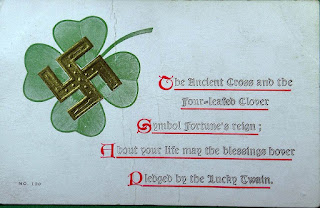
  "The Druid symbol is the four-leaf clover , considered up to the present as a sign of good luck and happiness. It is a non-existent flower already.  The four-leaf clover is a swastika that spins, forming a double eight, sign of eternity, of the twice born, of the immortality won in hard combat. It is also a carbuncle fallen from the sky. It is the Gral.  Furthermore, it symbolizes the division of society into four and the harmonious organization of the world of those times. The Druid was seated in the center of that flower."   Excerpt from The Golden Cord, 1978.

Fairy Faith

Image
  In the Celtic Fairy Faith the "Liminal Gods" are those who occupy the place between the Gods and the Fair Folk.   The Liminal Gods , as the term implies, occupy the transitional area between the Gods and the Fairy Folk. According to Morgan Daimler there are many, but four of the prominent liminal Gods are,  -  The Lady of the Greenwood ,  - The Lord Of The Wildwood ,  - The Queen of the Wind , and the Hunter .  - The Lady of The Greenwood and  - Lord of the Wildwood are associated with the summer half of the year and the Queen of the Wind and The Hunter the Winter half.

Creation Myth part 5: The Celts

Image
  Part 5 of my # CreationMyth series will cover the story as told by the Celts .  Although the Celts are one of many folks who practiced oral traditions and have (almost) no written accounts thankfully through their many interactions with the Romans and Roman Empire written records of their looks, their culture and their beliefs. So here we go! The Celtic creation myth! Once upon a time, there was no time. There were also no gods and no man or woman to walk the land. There was only the sea and its deep depths and dark eternal quiet. A strain of melody moved across the water, a whisper at first. The music was the Oran Mór (Great Melody) and it grew into a great spiraling, gathering sound and gaining momentum reaching further and louder till it reached a great crescendo. Then, where the sea met the land a sea-mare was born. White, and made of sea-foam and her name was Eiocha . Not far from where the land met the sea, a tree grew, a strong and sturdy oak. On the oak grew a p...

The Tuatha Dé Danann

Image
  The Tuatha Dé Danann , the people of the Goddess Danu , were one of the great ancient tribes of Ireland . The important manuscript 'T he Annals of the Four Master s', records that they ruled Ireland from 1897 B.C. to 1700 B.C.   The arrival of the tribe in Ireland is the stuff of legend. They landed at the Connaught coastline and emerged from a great mist. It is speculated that they burned their boats to ensure that they settled down in their new land. The rulers of Ireland at the time were the Fir Bolg , led by Eochid son of Erc , who was, needless to say, unhappy about the new arrivals. The Tuatha Dé Danann won the inevitable battle with the Fir Bolg but, out of respect for the manner in which they had fought, they allowed the Fir Bolg to remain in Connaught while the victors ruled the rest of Ireland . The original leader of the Tuatha was Nuada but, having lost an arm in battle it was decreed that he could not rightly be king. That honour went to Breas , a tribe...

Dana/Danu

Image
  In Celtic mythology, the goddess Danu, also known as Anu or Dana, is the ancient mother of all gods and of the Celtic people. She was thought to be both the original goddess and god, an all-encompassing deity who gave birth to everything and everyone. She’s often associated with Earth, waters, winds, fertility, and wisdom.   Although known as the great mother who gave life to all things and beings, not much is known about the goddess Danu, and her origin is shrouded in mystery. According to the early scholars, the name Danu is derived from an Indo-European word, which can be translated as the flowing one. Others believe that the word stems from the ancient Scythian language, meaning the river. For this reason, it was believed that the goddess represented the Danube River. In Irish or Celtic myths, the mysterious matriarch is mostly recognized through the story of the Tuatha Dé Danann, which means people of the goddess Danu. They were thought to be the o...

Triskelion

Image
The Celtic Triskelion symbol predates chrisitanity by about 3,000 years, arising out of La Tène culture and history. It is thought to represent the 3 stages of man (Life, Death, Eternity) and has been alluded to representing the triad of Earth, Sea and Sky.  Archaeological findings place it in Malta (4400–3600 BC) and in the astronomical calendar at the famous megalithic tomb of Newgrange in Ireland built around 3200 BC. The oldest evidence of triquetras completes the circle back to India. From this, it seems very likely that although no trace of the symbol has been located in the Asian region between India and Europe, tribes who had used it in these two faraway regions had either interacted or interbred somewhere along the line. So it is highly possible that the Aryans and/or other Indo-European tribes brought the triquetra to Europe.