Posts

Showing posts with the label goddess

The Zorya

Image
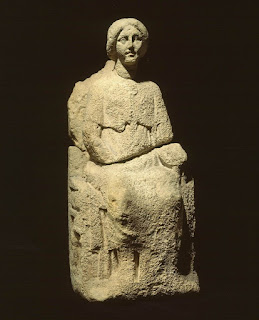
The Zorya are protective goddesses of the Slavs . Though they are an odd example being alternatively known as a Single goddess, two sisters, three sisters, and some even argue up to 5 sisters. Though the latter two are lost to time. They are said to watch the star Polaris to make sure Simargl does not get loose and consume the stars and the earth. They are looked to for protection by various tribes and are associated with the Morning , Evening , and Midnight stars. As a single deity she is said to be married to Perun and pull her veil over warriors in battle to protect them, while as a trio the Zorya are attendants of Dazbog opening the gates for him to enter and leave and then in the lap of Zorya the Midnight Star Dazbog will lay his elderly head down and die only to be reborn the next day as a youthful child and go across the sky again.
Frau Gode

Image
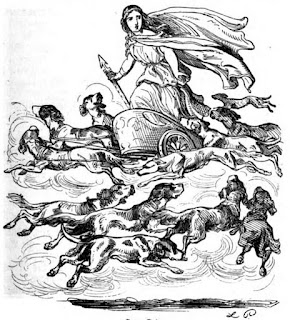
  Frau Gode is a North German goddess, she is often referred to as a "Dog Goddess" due to her symbolism and most notable story. Where a Euhemerized version of her appears with her daughters and a love for the Hunt, she then proclaimed that hunting was better than heaven, and when she did so again she and her daughters were cursed. With her myriad of daughters (over 20) turning into bitches, growing fur, muzzles, and paws. They then flew off with her as they lifted their mother and themselves into the air, some of the daughters even ended up tied to her chariot carrying it up into the sky as part of the Wild Hunt . Frau Gode was often said to "Curse" people by sending the dog spirits into the home of people where they would have to perform certain traditions to "get rid of" the dog. This was likely a ruse to allow themselves to continue pagan customs under the guise of removing a demonic curse.

Dana/Danu

Image
  In Celtic mythology, the goddess Danu, also known as Anu or Dana, is the ancient mother of all gods and of the Celtic people. She was thought to be both the original goddess and god, an all-encompassing deity who gave birth to everything and everyone. She’s often associated with Earth, waters, winds, fertility, and wisdom.   Although known as the great mother who gave life to all things and beings, not much is known about the goddess Danu, and her origin is shrouded in mystery. According to the early scholars, the name Danu is derived from an Indo-European word, which can be translated as the flowing one. Others believe that the word stems from the ancient Scythian language, meaning the river. For this reason, it was believed that the goddess represented the Danube River. In Irish or Celtic myths, the mysterious matriarch is mostly recognized through the story of the Tuatha Dé Danann, which means people of the goddess Danu. They were thought to be the o...

Nehalennia

Image
  Nehalennia (Celtic: "she of the sea"): ancient goddess, venerated in the Roman age at the mouth of the river Scheldt.  All of them can be dated to the second and early third centuries CE. Most pieces show a young female figure, sitting on a throne in an apse between two columns, holding a basket of apples on her lap. Nearly always, there is a wolf dog at her side. In some cases, the fruit basket is replaced by something that looks like loaves of bread; in other cases, we can see the woman standing next to a ship or a prow. Several inscriptions inform us that the votive altar was placed to show gratitude for a safe passage across the North Sea, and we may assume that other altars were dedicated for the same reason. (Of course, this does not mean that all pieces were erected after a safe passage.) An example of a typical inscription: To the goddess Nehalennia, on account of goods duly kept safe, Marcus Secundinius Silvanus, trader in pottery with Britain, fulfilled his vow ...